5×7 Lacrosse Rebounder Net: Adjustable Pitchback Guide
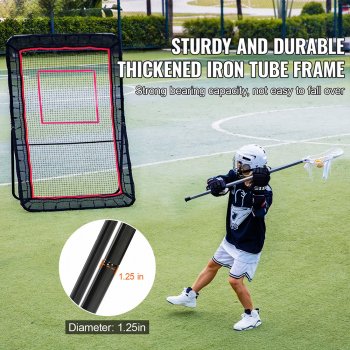
5×7 ft Lacrosse Rebounder Net: Adjustable Pitchback Training That Fits Real Life
Consistent reps build confident players, but getting quality throws and catches outside of team practice can be hard—especially when a partner isn’t available. A 5×7 ft rebounder net with an adjustable pitchback angle turns a driveway, backyard, or gym corner into a repeatable training station for lacrosse and other sports that reward timing, hand-eye coordination, and quick release. For more guidance, see Heavy Duty Baseball Rebounder Net – 4×4.5 FT, Pitchback With 3 ….
Why a rebounder belongs in a serious training setup
When you don’t have a wall, a teammate, or time for a full workout, a rebounder keeps training simple: throw, catch, reset, repeat. Our team likes rebounders for one main reason—they reduce “wasted minutes” and increase “clean reps.” For further reading, see Soozier Multi-Use Pitchback Rebounder Net – 10 Sq Ft Target, Steel ….
- Creates reliable, repeatable returns so you can focus on form instead of chasing loose balls.
- Supports solo training for catching mechanics, stick control, soft hands, and reaction time.
- Helps turn short windows of free time into productive practice—before school, after dinner, or between team sessions.
- Works as a skill bridge between coached practice and game speed: build muscle memory first, then add tempo.
If you want a deeper rules-and-development perspective, you can also reference USA Lacrosse and the competitive landscape on NCAA Lacrosse.
What the 5×7 ft size changes for training
A 5×7 ft face is a sweet spot for real-life practice: big enough to keep reps flowing, compact enough to fit many home setups with smart spacing. The larger catching area doesn’t replace accuracy—it makes it easier to stay in a productive rhythm while you build it.
- A larger face gives more usable target area, helpful for beginners learning accuracy and for advanced players adding speed.
- More forgiving for off-axis throws and quick-stick exchanges—fewer dead reps and fewer interruptions.
- Better for multi-sport use because the target area accommodates different ball sizes and trajectories.
- Pairs well with a goal-style training mindset: aim small within a bigger surface to build precision under fatigue.
Adjustable pitchback angles: how to use them on purpose
An adjustable pitchback is most valuable when you treat the angle like a coaching tool, not a random knob. Changing the return changes the timing demand—and that’s where skill grows.
- Lower angles can mimic flatter, faster returns for quick-stick catches and rapid release sequences.
- Higher angles can produce more pop-up style returns to challenge tracking and body positioning.
- Angle changes keep sessions fresh: alternate between “hands speed” sets and “tracking + footwork” sets.
- Use angle as a difficulty dial: start easy for clean reps, then increase challenge only after consistency is stable.
Multi-sport training ideas (lacrosse-first, not lacrosse-only)
If your household moves from sport to sport across the year, a rebounder can stay relevant with a few simple guardrails: use an appropriate ball for the sport, keep distances sensible, and prioritize clean technique over max power.
- Lacrosse: wall-ball style rhythms, one-cradle quick-release, alternating hands, catch-to-switch drills.
- Baseball/softball: glove work with controlled throws (focus on clean fielding position and quick transfer mechanics).
- Soccer: controlled volleys and first-touch practice (keep distances sensible and prioritize technique over power).
- Hockey/off-ice: hand-eye and reaction training with safe, appropriate balls in a controlled area.
- General athletic development: short reaction sets (10–20 reps) to build focus under mild fatigue.
A simple weekly plan that actually gets used
Consistency beats intensity for at-home skill work. Our team recommends planning for sessions you’ll realistically complete—even on busy weeks—then letting the reps compound over time.
| Block | Time | Focus | Rep idea |
|---|---|---|---|
| Warm-up | 3 min | Soft hands + rhythm | Easy throws to center, catch, reset stance |
| Quality | 6 min | Mechanics | 10 clean reps each hand; pause and reset after any miss |
| Speed | 4 min | Quick release + reaction | Short sets of 8–12 rapid catches/throws; rest briefly between sets |
| Cool-down | 2 min | Control under fatigue | Slow it down; perfect form on both hands |
Where to set it up (and how to keep practice smooth)
Who this rebounder setup fits best
In-stock picks from our store
- 5×7 ft Lacrosse Rebounder Net – Adjustable Pitchback for Multi-Sport Training
- One Room, Real Progress: A Simple Step-by-Step Guide for Stress-Free Home Organization (handy for keeping balls, cones, and gear grab-and-go)
- Maximize Function, Minimize Clutter | Multifunctional Room Layouts eBook (helpful if you’re carving out a small training corner)
FAQ
Is a 5×7 ft rebounder too big for a small yard or driveway?
It can still work well in a compact space if you have a safe throwing lane and enough side clearance for your follow-through. Start closer, keep the area tidy, and prioritize controlled reps over high-power shots.
How should the pitchback angle be set for beginners vs. advanced players?
Beginners do best with a moderate, predictable return so they can repeat clean mechanics and build confidence. Advanced players can rotate angles to create faster or more variable returns, using angle changes as a progressive challenge rather than a constant switch.
Can one rebounder realistically support multiple sports?
Yes—especially with a larger target area and adjustable angle, which makes the rebound pattern more versatile. Use sport-appropriate balls and distances, and keep intensity at a level that protects your surroundings and your technique.






Leave a comment