Gentle Positivity Toolkit: Low-Energy Self-Care Bundle

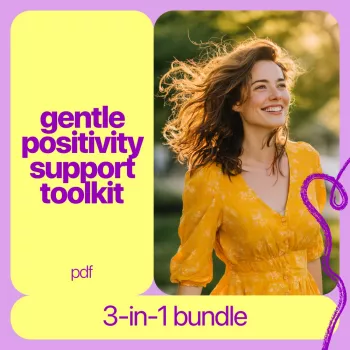
Gentle Positivity Support Toolkit: A 3-in-1 Digital Bundle for Emotional Support and Self-Care
Some days, “think positive” can feel impossible—especially when mood is low, energy is limited, and thoughts spiral. A gentle approach focuses less on forcing optimism and more on building small, repeatable supports that make hard moments a little more manageable. The Gentle Positivity Support Toolkit is a 3-in-1 digital bundle designed to help create steadier emotional footing through practical printable guides, eBooks, and checklists. It’s built for low-pressure progress: short exercises, simple routines, and prompts that encourage kinder self-talk and calmer decision-making when motivation is depleted.
For background on depression symptoms and support options, the National Institute of Mental Health offers a clear overview. For practical resilience skills that pair well with gentle routines, the American Psychological Association breaks down strategies in plain language.
What “gentle positivity” looks like on difficult days
Gentle positivity isn’t pretending everything is fine. It’s the skill of creating just enough steadiness to get through the next hour—and doing it without adding shame when you can’t do “all the things.”
- Acknowledges reality first: naming what hurts without judgment before shifting perspective.
- Uses micro-steps: short actions (1–5 minutes) that reduce overwhelm and increase follow-through.
- Builds emotional safety: prompts and checklists that help slow down spirals and support self-compassion.
- Focuses on support, not perfection: progress is measured by steadiness and recovery time, not constant happiness.
On a hard day, gentle positivity might look like: “Today is heavy. I can still do one small thing that makes it 2% easier.” That’s not hype—it’s a workable baseline.
What’s inside the 3-in-1 digital bundle
The Gentle Positivity Support Toolkit (3-in-1 Digital Bundle) brings together tools you can return to when you don’t have the bandwidth to “figure it out” from scratch.
- Printable guides that make it easier to start when energy is low (quick prompts, grounding steps, simple plans).
- eBooks that explain supportive mindset shifts in a calm, structured way—without relying on hype or forced positivity.
- Checklists for repeatable self-care basics (sleep, hydration, movement, boundaries, reaching out) that can be customized.
- Digital format for flexible use: print what helps, save to a device, revisit sections as needed.
Common components and how they help
| Component | Best for | Example outcome |
|---|---|---|
| Printable guides | Fast support during a tough moment | A 3-step reset to slow racing thoughts |
| eBooks | Understanding patterns and building a steadier mindset | A clearer plan for responding to negative self-talk |
| Checklists | Consistency when motivation fluctuates | A simple daily baseline routine that feels doable |
How to use the toolkit when depressed (without forcing positivity)
When depression is present, the goal often isn’t to “feel great.” It’s to reduce friction, soften inner pressure, and make supportive actions easier to access.
- Start with “minimum viable care”: choose 1–2 basics (water, food, fresh air, short shower) before any mindset work.
- Use a timer: commit to 2 minutes with a prompt or checklist; stop when the timer ends to avoid burnout.
- Swap “positive thinking” for “balanced thinking”: replace absolute statements (“always,” “never”) with neutral alternatives.
- Plan for relapse days: pick a pre-made “low energy” checklist so decisions are already simplified.
- Track signals, not scores: notice what slightly reduces tension or increases steadiness, even if mood stays heavy.
A helpful rule: if an exercise triggers pressure or perfectionism, scale it down. One sentence is enough. One checkbox is enough. The win is returning to support without needing a perfect mood first.
A simple 7-day gentle routine (adaptable and low-pressure)
This routine is intentionally small. Repeat days as needed, skip what doesn’t fit, and treat it like a menu—especially if energy changes day to day.
- Day 1: Pick one anchor habit (e.g., morning water or evening screen dimming) and keep it tiny.
- Day 2: Use one printable prompt to name the hardest thought and rewrite it into a more neutral sentence.
- Day 3: Choose one soothing action (music, warm drink, brief walk) and add it to a checklist.
- Day 4: Identify one stress trigger and one boundary that reduces exposure (even slightly).
- Day 5: Practice a 60-second grounding routine (breath, senses, posture) when spirals start.
- Day 6: Write a “support script” for reaching out (short text template) to reduce social friction.
- Day 7: Review what helped a little; keep only the parts that felt doable and repeat next week.
If the environment contributes to stress, pairing emotional routines with a small, contained organizing plan can help reduce daily overwhelm. The companion-friendly approach in One Room, Real Progress: A Simple Step-by-Step Guide for Stress-Free Home Organization supports quick wins without turning your home into another pressure project. For tight spaces and “everything feels in the way” fatigue, Maximize Function, Minimize Clutter | Multifunctional Room Layouts eBook can help simplify layouts so daily tasks take less effort.
Who this toolkit can help most
Helpful boundaries and when to get extra support
FAQ
Can this help even if motivation is very low?
Yes. The toolkit is designed around low-effort entry points like micro-steps, short timers, and checklists that reduce decision fatigue, so you can start with the smallest doable action and stop before you burn out.
Do the materials need to be printed to be useful?
No. You can print only the pages you like, or use the files digitally on a phone, tablet, or computer and revisit favorite prompts and checklists whenever you need them.
Is this a replacement for therapy or medical treatment?
No. It’s a self-care and coping support resource, not medical advice or treatment; if symptoms are severe, persistent, or worsening, professional support is important, and urgent situations require immediate local help.




Leave a comment